
How a limestone ridge above Lake Van became one of the ancient world’s most layered monuments — and what the Persian king’s carved declaration still tells us today
The first thing you notice about Van Fortress is that it should not have survived. Empires rose and collapsed around it. Earthquakes shook the eastern Anatolian plateau. Wars erased the medieval city at its foot so completely that today only the fortress remains, hovering above a plain where a thriving Ottoman town once stood. And yet here it is: two kilometers of limestone ridge, riddled with royal tombs, crowned with mud-brick walls, and engraved — in three languages — with the boast of a Persian king who died nearly 2,500 years ago. To walk the base of Van Fortress is to move through time more steeply than almost anywhere else in the ancient world.
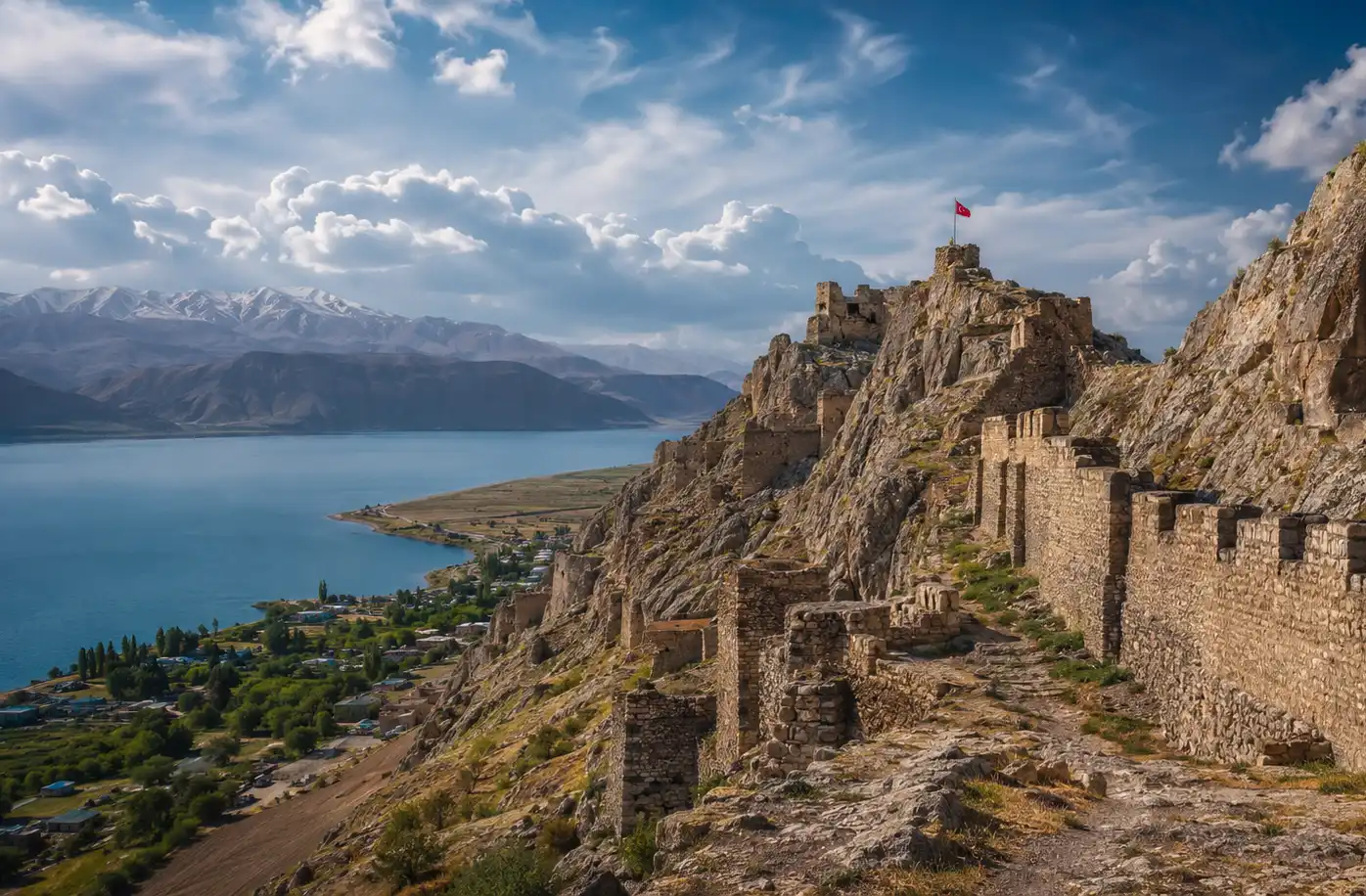
The site sits on the eastern shore of Lake Van in what is now southeastern Turkey, near the modern city of Van. Lake Van itself is a geological curiosity — the largest lake in Turkey, a high-altitude, alkaline body of water with no outlet, so mineral-rich that it sustains a unique ecosystem and an almost supernatural blue color. The ridge that holds the fortress rises abruptly from this landscape, a natural spine of rock roughly 80 meters tall at its highest point, running east to west like a ship’s keel above the plain. Ancient peoples did not create this elevation. They found it and understood, with the political instinct that produced all great capitals, exactly what it meant.
Van Fortress rises above the eastern shore of Lake Van — one of the most layered archaeological landscapes in the ancient world.
The Kingdom That History Forgot: Urartu and the Making of Tushpa
Van Fortress begins, in its monumental form, with a civilization that modern audiences rarely encounter: the Kingdom of Urartu, which dominated the highland regions around Lake Van from roughly the ninth century BCE until its collapse under Scythian and Median pressure around 590 BCE. Urartu is not obscure because it was minor. It was one of the most formidable powers of the ancient Near East, the principal rival of Assyria for nearly two centuries, and a state of impressive sophistication in hydraulic engineering, metalwork, and territorial organization. It is obscure because it left no literary tradition that survived in canonical form, because its successors wrote it out of history, and because the Assyrians — who hated and feared it — were the ones who preserved its name.
The Urartian king Sarduri I, who ruled around 832–820 BCE, chose the Van ridge as his capital and named it Tushpa. His foundation inscription — carved in Assyrian cuneiform, the diplomatic language of the age, before Urartu developed its own script — survives in fragments and announces his ambitions without modesty. Subsequent kings, particularly Menua (r. ca. 810–785 BCE) and the expansionist Argishti I (r. ca. 785–753 BCE), transformed the capital from a regional stronghold into the center of an empire stretching from modern Iran to the upper Euphrates.
What makes Tushpa architecturally remarkable is the relationship between construction and landscape. Urartian builders did not fight the topography; they read it and amplified it. The long ridge provided a natural platform for citadel construction, and massive stone masonry walls — built from precisely dressed basalt and limestone blocks, many weighing several tons — were added along the northern and southern faces to close the gaps that nature had left. These walls were not decorative. Urartian military architecture was functional to a precise degree, integrating towers at irregular intervals calibrated to the specific angles of approach below, and using the cliff edges themselves as the primary barrier on the more precipitous southern face. The result was a fortress that felt, from a distance, as though the mountain itself had decided to become a stronghold.
Inside the upper citadel, Urartian builders constructed a sacred precinct, storage magazines for grain and wine, and residential quarters for the royal household. Archaeology has revealed the foundations of temples dedicated to Haldi, the principal deity of the Urartian pantheon — a war god of martial temperament whose favor was invoked before every military campaign. Beneath the ridgeline on the southern face, cut directly into the living rock, the Urartian kings carved a series of chamber tombs that remain among the most impressive rock-cut monuments in the Middle East. These tombs — rectangular chambers accessed through narrow passages, their walls smoothed and their doorways framed with carved stone — were intended not only as royal burial places but as permanent statements of dynastic legitimacy, as impossible to ignore as the mountain itself.
How a Fortress Becomes an Archive: Layers of Occupation
When Urartu collapsed in the late seventh century BCE, Van did not collapse with it. This is the essential paradox of great sites: they outlast the civilizations that create them, because the conditions that made them significant do not change when political systems do. The ridge was still elevated. The lake was still vast. The plain below was still the most productive agricultural land for a hundred kilometers in any direction. Whoever controlled Van controlled the eastern Anatolian plateau.
The Medes and then the Achaemenid Persian Empire absorbed the region during the sixth century BCE, and Van entered a new phase — not as a destroyed ruin but as an inherited landscape that Persian imperial culture treated with characteristic intelligence. The Achaemenids were sophisticated administrators. Where other empires leveled what they conquered and built afresh, the Persians often recognized value in existing structures, local elites, and established meanings. At Van, this meant that the fortress became a Persian administrative center, likely garrisoned and maintained, incorporated into the satrapial system that organized the vast territories between the Aegean and Central Asia. Persian rule left little direct architectural imprint on the fortress itself, but it left something more indelible: words carved into stone that were meant to last forever.
Following the Achaemenid period, Van passed successively through Armenian kingdoms — particularly the Kingdom of Ararat and later the broader Armenian historical sphere — into Roman and Parthian frontier zones, then into Byzantine and Sassanid contested territory. Medieval Armenian princes maintained the fortress, and Islamic dynasties including the Seljuks and later the Kara Koyunlu and Ak Koyunlu Turkmen confederations held it as a regional stronghold. The Safavid and Ottoman empires fought for Van repeatedly through the sixteenth century, with the Ottomans securing it definitively in 1548. Each of these occupants modified, repaired, or added to what was already there. Ottoman walls reinforced Urartian foundations. Medieval mosques stood near ancient temple platforms. The fortress had become, over three millennia, a palimpsest in stone.
The Inscription of Xerxes: When a King Wrote on a Mountain
Of all the interventions at Van across three thousand years of history, one stands out for both its audacity and its precision: the inscription of Xerxes I, carved high into the southwestern face of the rock during the first half of the fifth century BCE. This is not simply an interesting epigraphic find. It is one of the most striking acts of monumental political communication to survive from the ancient world.
Xerxes I — Khshayarsha in Old Persian — ruled the Achaemenid Empire from 486 to 465 BCE. He is best known in Western history through the Greek lens of the Persian Wars: the king who bridged the Hellespont to invade Greece, who burned Athens, who was defeated at Salamis and Plataea. But this is a profoundly distorted portrait. Xerxes ruled an empire of staggering scale and administrative complexity, from the Aegean to the Indus Valley, and his reign involved far more than its ultimately unsuccessful western campaigns. He was also a builder, a theologian of Ahura Mazda, and a communicator of imperial ideology through exactly the kind of monumental inscription he left at Van.
The inscription — known to scholars as XV (Xerxes Van) — is carved into a carefully prepared rectangular niche cut into the cliff face, positioned at a height that makes it visible from a considerable distance below. It is trilingual, in the standard Achaemenid royal tradition: the same text appears in Old Persian, Elamite, and Babylonian Akkadian, the three administrative languages of the empire. The text itself follows the well-established formula of Achaemenid royal inscriptions. It opens with the declaration of Ahura Mazda’s greatness, identifies Xerxes by his full titulature — “great king, king of kings, king of lands, son of Darius the king, an Achaemenian” — and asserts his divine sanction and universal sovereignty.
What makes the Van inscription particularly fascinating is the question of its site. There is strong evidence that the niche in which the inscription sits was originally prepared by the Urartians — that is, the cut stone recess existed before the Persian text was carved into it. If this is correct, then Xerxes did not simply find a blank cliff and write upon it. He found an Urartian architectural gesture, possibly intended for a relief or an earlier inscription that was never completed, and used it as his medium. This transforms the inscription from a simple act of writing into a layered political statement: Persian authority does not replace what came before, it inherits it, completes it, and supersedes it. The mountain’s history becomes part of the message.
The visual effect of the inscription from below would have been immediate and unmistakable even for the illiterate majority of ancient populations. A rectangular frame, cut precisely into the cliff face, filled with dense columns of text, positioned on the most famous landmark for hundreds of kilometers in every direction. You did not need to read cuneiform to understand that a great power had marked this place as its own. The mountain spoke, and it spoke in the king’s name.
For those who could read, or who had the inscription read to them, the message was theology as much as politics. Xerxes’ inscriptions consistently emphasize the worship of Ahura Mazda and the rejection of what Achaemenid texts call “the Lie” — the cosmic principle of disorder, deception, and rebellion against righteous order. The Van inscription, like those at Persepolis and Naqsh-e Rostam, situates imperial power within a framework of divine will. The king rules because the god wills it; the empire endures because it is righteous; those who resist it resist the cosmic order itself.
This theological dimension places the inscription in a tradition of ancient monumental writing that is fundamentally different from modern commemorative texts. We write on monuments to record events or honor individuals. Achaemenid royal inscriptions were performative: they enacted authority by stating it, repeatedly, in stone, across the empire, in places where the words would endure long after the king who commissioned them had died.
Xerxes was assassinated in 465 BCE. His inscription at Van has now stood for nearly 2,500 years.
The Architecture of Survival: What Van Tells Us About Permanence
Van Fortress did not survive because of any single civilization’s care. It survived because geography is not optional. The ridge endured every political change, every dynastic transition, every shift in the regional balance of power, because the conditions that made it strategically and symbolically significant were not human inventions. They were geological facts that human ambition attached itself to across millennia.
This is perhaps the deepest lesson Van Fortress offers to anyone interested in architecture and history. We tend to attribute the survival of ancient monuments to construction quality, to the durability of specific materials, or to the accidental mercy of invaders. These factors matter. But the monuments that survive the longest are almost always those that remain meaningful across political changes — those whose significance is so tied to natural landscape, to geography, or to a widely shared symbolic vocabulary, that each new occupant finds it more useful to inherit them than to erase them.
Every civilization that held Van recognized what the ridge meant. Every empire that carved its name or built its walls upon it was acknowledging that it had inherited something older and deeper than any single political system. The Urartians built their capital here. The Persians wrote their theology here. The Armenians, Romans, Seljuks, and Ottomans each added their own layers. And today, when visitors climb the path to the citadel and look out over the impossible blue of Lake Van — a view that Sarduri I and Xerxes and countless commanders after them also looked out over — they are participating in one of the longest unbroken chains of human meaning-making that the ancient world has left us.
The Xerxes inscription, still perfectly legible after twenty-five centuries, remains the site’s most eloquent single statement. It tells us the king’s name and his god’s name and his claim to the world. But the more interesting thing it tells us is this: even the greatest empire in the world, at the height of its power, found it necessary to come to this ridge and write upon it. Not to build upon it, not to destroy what was here before, but to add its voice to a conversation that had already been going on for four centuries when Xerxes was born.
Epilogue: The City That Disappeared
There is one more layer to Van’s history that any honest account must include. At the base of the fortress, through much of the medieval and early modern period, stood the city of Old Van — a substantial urban settlement of mosques, markets, and residential quarters that grew organically in the shadow of the ridge over centuries of Ottoman rule. In 1915 and 1918, the city was destroyed in the catastrophe of the First World War and its accompanying violence. Today nothing remains of Old Van except foundations and scattered walls visible in the plain. The modern city of Van was rebuilt several kilometers to the east.
Van Fortress now stands, therefore, not only as an archaeological monument but as a witness to a more recent and painful absence. The site carries the weight of all its layers: Urartian, Persian, Armenian, Ottoman, and modern. This is not incidental to its meaning. It is its meaning. A fortress that has seen the rise and fall of a dozen civilizations and the destruction of its own surrounding city in living memory is not a static relic. It is a record of everything that built things and everything that destroyed them, still standing at the edge of a blue lake in eastern Turkey, waiting, as it has always waited, for whoever comes next.
Van Fortress (Tushpa) is an open-air archaeological site managed by the Turkish Ministry of Culture and Tourism. The Xerxes inscription is protected as part of the site’s cultural heritage zone. The fortress and the rock-cut Urartian tombs are accessible by a path along the southern face of the ridge.
