
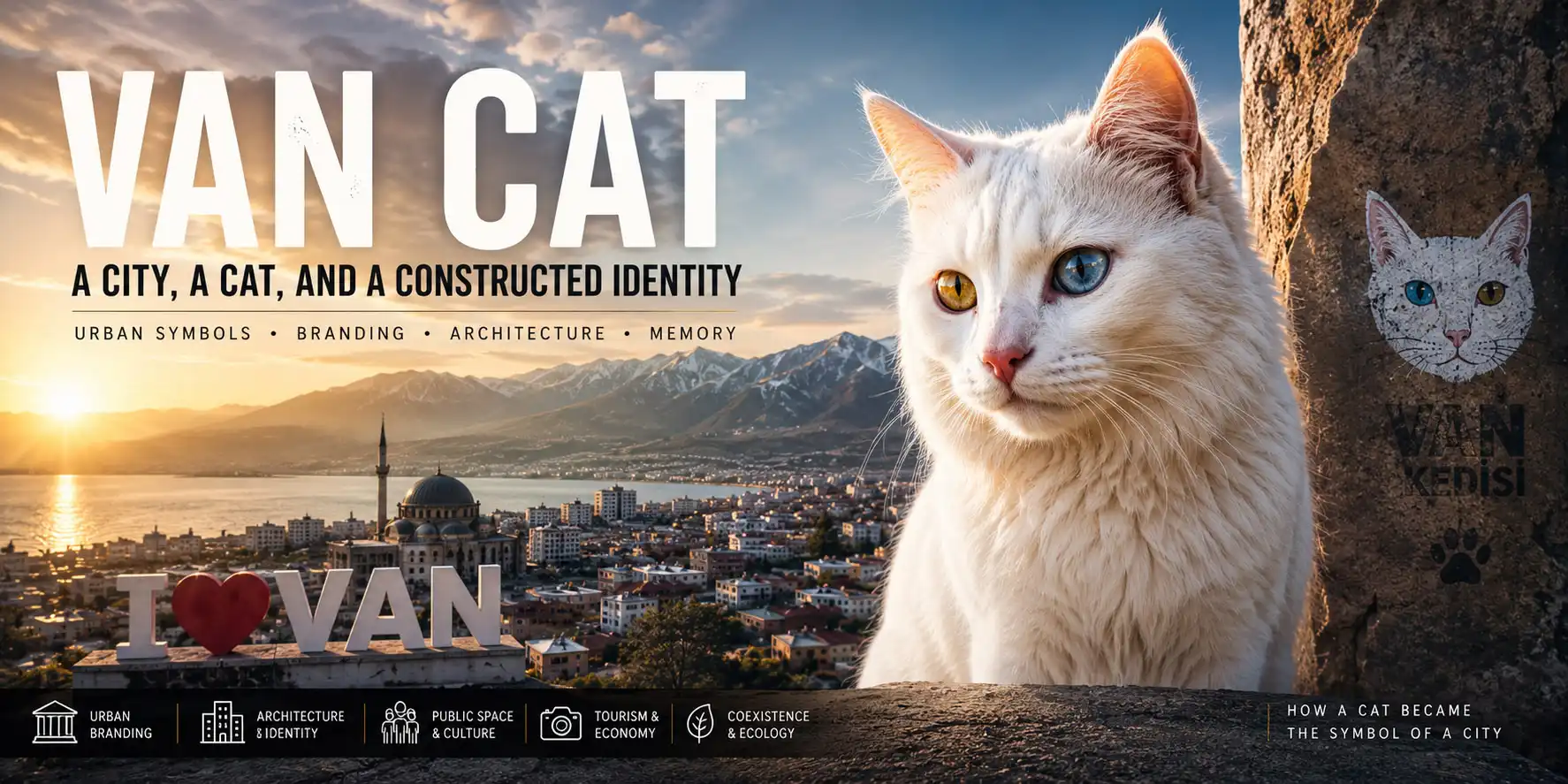
Introduction: When a City Chooses a Face
Cities are rarely remembered through their full complexity.
No visitor leaves a place carrying every street, every building, every voice, or every memory equally. Urban memory is selective. Some places become associated with monuments, others with food, some with colors, and still others with a single image repeated often enough to become inseparable from the city itself.
Paris has the Eiffel Tower. New York has the skyline. Venice has canals.
In eastern Turkey, Van is home to a white cat.
The Van Cat — famous for its white fur and often heterochromatic eyes — is more than a regional animal. It has become a cultural and visual identity system embedded throughout the city. Its image appears on souvenirs, murals, airport graphics, public signage, tourism branding, social media content, local institutions, and collective memory.
But this transformation raises an important urban question:
How does a living creature become part of a city’s architectural and symbolic identity?
More importantly, what does this process reveal about urban branding, public memory, tourism, and the relationship between human settlements and non-human life?
This article explores the Van Cat not merely as an animal, but as an urban phenomenon — one that intersects architecture, branding, spatial design, tourism infrastructure, emotional connection, and environmental consciousness.
Watch the Film
Van Cat — A City, A Cat, and a Constructed Identity
Cities as Systems of Repetition
Urban identity is not accidental.
Cities are remembered through repetition.
A successful urban symbol is not simply recognizable; it is continuously reinforced across physical space, media, architecture, commerce, and everyday life.
This repetition creates familiarity. Familiarity creates memory. Memory creates identity.
Urban branding, therefore, operates similarly to architectural framing. It guides perception. It selects certain narratives while minimizing others. A city may contain thousands of stories, yet only a few are amplified enough to become part of its external image.
In Van, the cat functions as one of these amplified narratives.
The image of the Van Cat is repeated through:
- Souvenir shops
- Tourism advertisements
- Sculptures and public installations
- Cafes and retail graphics
- Airport imagery
- Social media photography
- Municipal branding
- Visitor attractions
- Cultural references
- Local memory
This is not merely decoration.
It is urban semiotics.
The city gradually constructs a symbolic ecosystem in which the cat becomes shorthand for place itself.
The process resembles how architectural landmarks operate. A building becomes symbolic when repeated through postcards, films, digital media, and tourism campaigns. Eventually, the representation becomes stronger than direct experience.
Many visitors know cities through symbols before they ever physically enter them.
The Van Cat functions similarly.
The animal becomes a visual portal through which outsiders first encounter the city.
The Van Cat as Urban Brand
Branding is often associated with corporations, products, or marketing strategies, but contemporary cities increasingly operate as brands themselves.
Cities compete globally for:
- Tourism
- Investment
- Cultural recognition
- Media visibility
- International attention
- Emotional memorability
As a result, municipalities and tourism systems seek distinctive identity markers capable of differentiating one place from another.
This differentiation becomes especially important in an era where digital platforms compress geographic experience into scrollable imagery.
A city needs symbols that can survive visual overload.
The Van Cat succeeds because it combines several powerful qualities simultaneously:
1. Visual Uniqueness
The heterochromatic eyes immediately attract attention.
The cat’s appearance is memorable even to viewers with no prior knowledge of the city.
2. Emotional Accessibility
Animals create immediate emotional engagement.
Unlike monumental architecture, which may require historical or cultural literacy, animals produce intuitive responses.
3. Photographic Potential
The Van Cat is highly shareable in digital culture.
Its image performs effectively on social media platforms where visual distinctiveness drives circulation.
4. Symbolic Softness
Unlike political or ideological symbols, animals often appear universally approachable.
This makes them effective for tourism branding.
5. Local Specificity
Although cats exist globally, the “Van Cat” creates regional uniqueness.
The city claims symbolic ownership through naming.
Together, these qualities transform the cat into a highly efficient urban identity device.
Yet branding alone does not explain the phenomenon.
The deeper transformation occurs through architecture and spatial experience.
Architecture as Framing Mechanism
Architecture does not simply shelter life.
It frames perception.
The design of space determines:
- What becomes visible
- What remains hidden
- How visitors move
- Where they pause
- What they photograph
- How they emotionally interpret place
This becomes especially evident in environments built around animals.
The Van Cat Research Center is not merely a facility for housing cats. It functions as a spatial narrative system.
Visitors do not encounter the cats randomly.
Their experience is choreographed.
Movement paths, viewing distances, transparent boundaries, circulation patterns, and moments of pause are all structured architecturally.
The result is a carefully mediated relationship between humans and animals.
Architecture becomes the interface.
The visitor enters slowly. Observes carefully .Photographs intentionally.Pauses emotionally.
What appears natural is often spatially designed.
This is one of architecture’s most powerful yet invisible functions.
Good architecture often conceals its own control systems.
The Van Cat Center simultaneously performs several roles:
- Conservation facility
- Tourism attraction
- Educational space
- Emotional experience
- Urban branding infrastructure
- Public interface
This overlap reveals an important aspect of contemporary urbanism:
Cities increasingly create spaces not only for utility, but for symbolic interaction.
People do not merely consume architecture physically.
They consume it emotionally and digitally.
The architecture, therefore, supports not only physical movement but also image production.
In the age of social media, spaces are increasingly designed to be photographed.
The Van Cat itself becomes part of this image economy.
Human-Animal Interaction and Emotional Urbanism
Urban branding succeeds most effectively when it produces emotional participation.
People remember places through feeling.
This explains why the Van Cat experience extends beyond observation.
Visitors feed the cats. Children interact with them. People kneel to photograph them. Hands reach outward to pet them. Families gather around them.
The emotional exchange becomes part of the city experience.
This matters because contemporary tourism increasingly prioritizes emotional authenticity over passive sightseeing.
People seek:
- Connection
- Interaction
- Participation
- Memory
- Sensory engagement
Animals naturally facilitate these experiences.
Unlike monuments, animals respond.
Even small movements — a glance, a pause, a gesture — create perceived intimacy.
This intimacy strengthens memory.
The result is what might be called emotional urbanism:
A form of urban experience in which emotional encounters become central to how cities are remembered.
Importantly, this process also reshapes public perception of urban life itself.
Cities are no longer viewed purely as human systems.
They become ecosystems of coexistence.
The presence of animals softens the psychological hardness often associated with urban environments.
In Van, the cat becomes both symbol and emotional mediator.
It connects visitors to a place through affection rather than spectacle.
Tourism, Memory, and Shareable Cities
Tourism today is inseparable from media production.
Visitors no longer simply experience cities.
They document them.
Urban experiences are increasingly designed around visual circulation.
A place becomes successful not only when visited, but when photographed, shared, reposted, and remembered digitally.
This changes the architecture itself.
Public spaces increasingly operate as stages for image production.
The Van Cat performs exceptionally well within this system because it merges several tourism dynamics simultaneously:
- Emotional engagement
- Visual uniqueness
- Cultural specificity
- Shareability
- Symbolic clarity
A photograph of the Van Cat immediately communicates:
- Place
- identity
- uniqueness
- narrative
This efficiency is critical in digital tourism culture.
Many cities struggle to produce distinctive visual signatures.
The Van Cat provides Van with an instantly recognizable image capable of circulating globally.
Importantly, this circulation extends beyond official branding.
Visitors themselves become branding agents.
Every shared image reinforces the association between the city and the cat.
Urban branding, therefore, becomes decentralized.
Tourists participate in identity construction.
This process reflects broader transformations in contemporary urban culture where public perception is increasingly generated collaboratively through digital media.
Cities no longer control their image entirely.
They guide it.
The Van Cat succeeds because the symbol is emotionally compelling enough for people to voluntarily reproduce it.
Collective Life and Urban Celebration
Cities are not remembered only through objects.
They are remembered through collective emotion.
Moments of celebration, gathering, music, movement, and shared experience often become more memorable than architecture itself.
In Van, scenes of dancing, public gathering, and collective joy reveal another dimension of urban identity.
Even when unrelated directly to the cat, these moments contribute to the emotional atmosphere surrounding the city.
Urban identity is cumulative.
People rarely separate architecture, culture, weather, animals, music, streets, and public emotion into isolated categories.
Memory blends them together.
A visitor may remember:
- The cat’s eyes
- The sound of music
- People dancing in the streets
- Evening light on the lake
- Birds above rooftops
- Children interacting with animals
- Public squares filled with movement
Together, these fragments produce urban atmosphere.
Architecture alone cannot create this.
Branding alone cannot create this.
Urban identity emerges through interaction between physical space and collective life.
This is why successful cities often feel emotionally coherent even when visually diverse.
The emotional rhythm of public life unifies them.
In this context, the Van Cat becomes part of a larger urban narrative about memory, coexistence, and shared experience.
Beyond Humans: The Hidden Lives of Cities
Modern urban planning has historically centered on human needs almost exclusively.
Roads.
Infrastructure.
Housing.
Transportation.
Commerce.
Yet cities are inhabited by far more than people.
Birds occupy rooftops and electrical lines. Butterflies depend on green spaces. Cats move through narrow streets. Dogs establish territorial relationships with neighborhoods. Insects shape ecological systems invisible to most urban residents.
These lives are often ignored in formal planning discourse.
And yet they significantly influence the urban atmosphere.
A city without birds sounds different. A city without animals feels psychologically harsher. A city without ecological diversity becomes emotionally sterile.
The Van Cat phenomenon unintentionally reveals an important urban insight:
Non-human life can become central to urban identity.
This raises larger architectural and planning questions:
What if cities consciously designed for coexistence?
What if urban branding expanded beyond monuments and skylines to include ecological relationships?
What if biodiversity became part of public identity?
Contemporary architecture increasingly discusses sustainability, but sustainability is often reduced to energy efficiency or material performance.
Ecological urbanism requires something broader.
It requires acknowledging that cities are habitats.
Not only for humans.
But for multiple forms of life.
Architecture, Ecology, and Coexistence
Architectural thinking is gradually expanding beyond human-centered frameworks.
Landscape urbanism, ecological design, and environmental planning increasingly recognize the importance of interspecies relationships.
Yet many cities still treat animals as either:
- decorative elements
- tourism tools
- sanitation problems
- or ecological afterthoughts.
The Van Cat introduces a more complex condition.
Here, an animal becomes culturally protected precisely because it becomes symbolically valuable.
This creates both opportunities and contradictions.
On one hand:
Branding can increase conservation awareness.
When people emotionally connect with a species, they may become more willing to support environmental protection.
On the other hand:
Symbolic visibility can also commercialize living creatures.
The tension between care and spectacle becomes unavoidable.
Architecture plays an important role within this tension.
The design of animal-centered spaces determines whether interaction becomes:
- exploitative
- educational
- respectful
- performative
- ecological
- or purely commercial.
The most meaningful spaces are those that balance:
- visibility
- protection
- education
- emotional connection
- ecological awareness
without reducing animals to mere entertainment.
This balance is increasingly relevant globally.
As climate anxiety and environmental concerns intensify, cities may need new symbolic systems capable of reconnecting urban populations with ecological consciousness.
Animals can become mediators within this process.
Not simply as mascots.
But as reminders that urban life remains biologically interconnected.
The Ethics of Urban Symbolism
Every urban symbol simplifies reality.
This simplification is both useful and dangerous.
A city cannot communicate itself through infinite complexity.
Symbols provide clarity.
But they also compress identity.
The Van Cat therefore exists simultaneously as:
- living creature
- cultural icon
- tourism device
- branding mechanism
- emotional trigger
- ecological presence
- media object
This layered condition raises ethical questions.
When does celebration become commodification?
When does visibility become reduction?
Can symbolic animals remain respected as living beings rather than functioning only as marketing imagery?
These questions matter increasingly in contemporary cities where branding often dominates urban policy.
Cities worldwide compete through carefully curated identities.
But branding that ignores ecological ethics risks becoming superficial.
The most successful urban identities are not artificially manufactured.
They emerge from authentic relationships between place, culture, environment, and collective memory.
The Van Cat remains powerful because its symbolism is rooted in lived urban experience.
Residents interact with the animal directly.
The symbol remains connected to physical reality.
This connection preserves authenticity.
Urban Memory and the Future of Symbolic Cities
Cities of the future may increasingly depend on symbolic coherence.
As globalization standardizes architecture, retail systems, infrastructure, and digital culture, many urban environments begin to resemble one another.
Distinctiveness becomes harder to maintain.
In response, cities search for identity anchors.
Some rely on historic monuments. Some rely on food culture. Some rely on festivals. Some rely on natural landscapes.
Van relies partly on a cat.
This may seem small.
But small symbols often become psychologically powerful precisely because they feel emotionally accessible.
People may admire skyscrapers.
But they often remember moments of intimacy more deeply.
A cat looking back. Children laughing. Birds above rooftops. A public square filled with music.An evening light reflected on the water.
Urban memory is emotional before it is analytical.
This explains why architecture alone cannot sustain identity.
Cities need atmosphere.
And atmosphere emerges through relationships between:
- space
- life
- movement
- ecology
- emotion
- repetition
- collective experience
The Van Cat becomes meaningful not only because it is visually unique.
It becomes meaningful because the city repeatedly integrates it into lived experience.
Conclusion: What the Van Cat Teaches Urbanism
The story of the Van Cat is ultimately not about a cat alone.
It is about how cities construct meaning.
It is about how architecture frames interaction.
How branding shapes memory.
How tourism transforms symbols.
How emotional experiences become urban identity.
And how non-human life continues to influence the character of cities in ways modern planning often overlooks.
The Van Cat reveals that urban identity does not emerge only from buildings, roads, and infrastructure.
It also emerges from relationships.
Between people and animals.
Between memory and place.
Between architecture and emotion.
Between branding and ecology.
Perhaps the future of urbanism depends partly on recognizing these hidden relationships more clearly.
Not every city needs a monumental skyline.
Some cities may instead be remembered through smaller forms of life woven quietly into collective memory.
A bird above a rooftop. A butterfly crossing a park. A dog resting beside a street.Or a white cat with two different eyes becomes the face of an entire city.
Author: Behzad M Yeganeh For Archiu.com

