
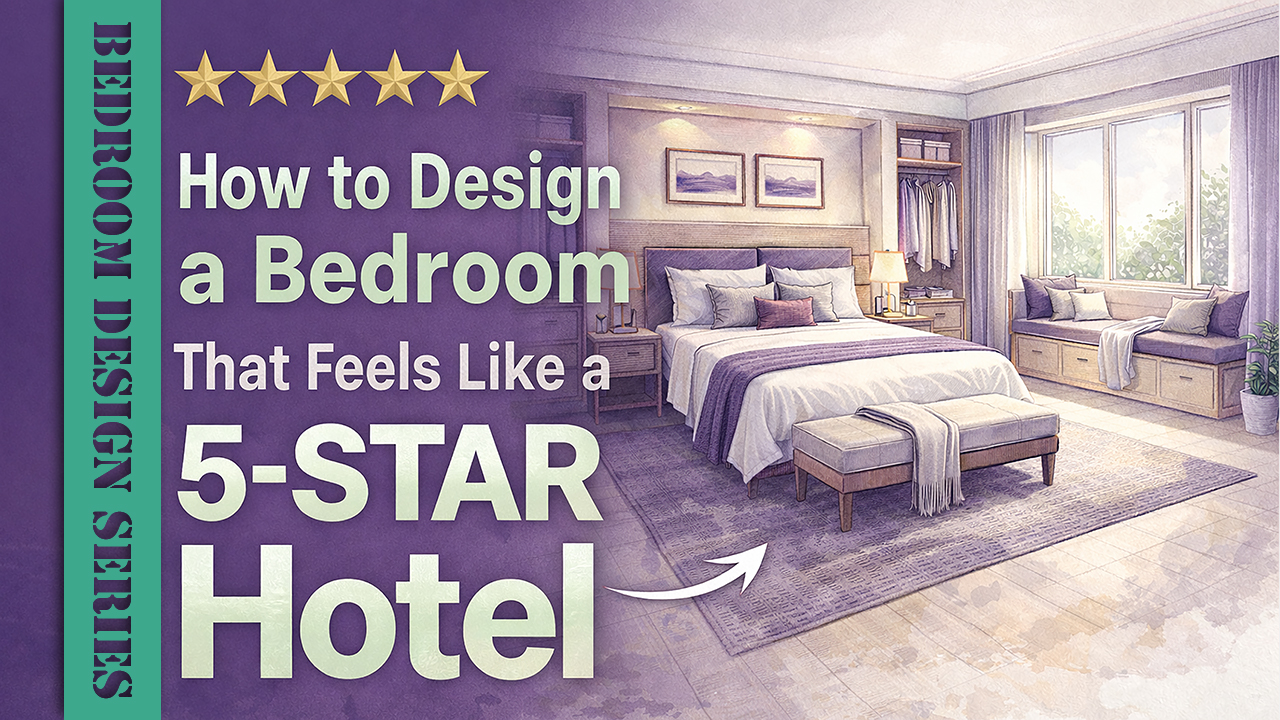
Understanding the System Behind Calm Bedrooms
This article is part of the Bedroom Design Series.
For the complete framework and structured overview, read the full guide: How to Design a Bedroom: A Function-Based Design Guide
Watch the Episode
Introduction: Calm Is Not Luxury — It Is Clarity
The reason hotel bedrooms feel better is not luxury.
It is clarity.
The best hotel rooms feel calm, balanced, and restorative because every design decision is intentional. Nothing is accidental. Nothing competes for attention. Everything supports one experience: rest.
This principle has very little to do with hotels — and everything to do with how bedrooms should be designed.
This article marks the beginning of a structured bedroom design series. The goal is not to replicate hotel aesthetics. The goal is to understand the professional logic behind designing a bedroom properly — starting with function, spatial relationships, and human behavior.
Why Some Bedrooms Feel Better Than Others
Most bedrooms do not fail because they are small, simple, or inexpensive.
They fail because they were just furnished — not designed.
There is a fundamental difference between placing objects in a room and organizing a space as a system.
A well-designed bedroom operates as a coordinated environment. The bed, lighting, circulation paths, materials, acoustics, and storage zones work together to support sleep and recovery.
Hotel bedrooms succeed because they are conceived as systems:
- Each element has a defined role
- Visual noise is reduced
- Movement is clear
- Light is controlled
- Materials are restrained
- The experience is cohesive
This systems-based thinking is the foundation of professional bedroom design.
Bedroom Design Begins With Function
Bedroom design does not begin with style.
It begins with function — and in this space, the primary function is sleep.
If a bedroom does not support high-quality sleep, no aesthetic intervention can compensate for that failure. Color palettes, lighting fixtures, textiles, or decorative objects cannot correct a fundamentally flawed layout.
However, the bedroom is not a single-function space.
It supports:
- Sleep and physical recovery
- Privacy and intimacy
- Daily transitions between day and night
- Dressing and undressing
- Storage of personal belongings
- Mental decompression
In many homes — especially master suites — the bedroom connects directly to an ensuite bathroom. The relationship between the bed, bathroom entrance, vanity, and shower becomes part of the bedroom’s functional logic.
Privacy, acoustics, lighting spill, and circulation all influence how the space feels.
A well-designed master bedroom treats the bedroom and bathroom as one coordinated system — not as disconnected rooms.
The Bed as a Spatial Anchor
In professional bedroom design, the bed is the primary spatial anchor.
Not because it is simply the largest object in the room, but because its position directly interacts with:
- The entrance
- Window placement
- Closet and wardrobe zones
- Bathroom connection
- Natural light direction
- Overall circulation
Bed placement does not act in isolation. It operates in coordination with these elements.
A poorly positioned bed can:
- Obstruct circulation
- Block light
- Reduce privacy
- Create psychological discomfort
A well-positioned bed supports clarity and balance.
But placement alone is not enough.
Bed Size, Type, and Spatial Balance
The size and type of the bed and mattress are equally critical design decisions.
A twin, queen, or king bed significantly alters spatial balance. Each dimension changes how much usable area remains for circulation and furniture placement.
If a bed is too small, comfort is compromised. If it is too large, circulation narrows, and the layout loses clarity.
Design considerations include:
- Mattress dimensions
- Bed height
- Headboard depth
- Clearance zones around the bed
- Whether the bed is fixed, pull-out, platform, or bunked
These are spatial decisions — not decorative ones.

Designing by Subtraction
Hotel bedrooms do not feel calm because they are empty.
They feel calm because unnecessary decisions have been removed.
Lighting is controlled rather than excessive. Materials are quiet rather than visually loud . Objects are organized around use rather than display.
This approach can be described as designing by subtraction.
Instead of continuously adding layers — more décor, more objects, more contrast — the designer removes distractions until the space clearly supports its function.
Calm is not created by emptiness.
It is created by clarity.
What This Series Will Cover
This series breaks down bedroom design into clear components:
- Designing based on function, not trend
- Correct bed placement within the layout
- Selecting appropriate bed and mattress dimensions
- Understanding circulation and spatial proportion
- Organizing storage zones without visual chaos
- Using lighting to support sleep and comfort
- Choosing materials and colors to enhance calm
- Designing for real life — not photographs
Style will be discussed — but as a result of good design decisions, not as a starting point.
Each topic stands on its own. Together, they form a complete design system.
Setting the Right Mindset
This first step is not about layouts or materials.
It is about mindset.
Designing a bedroom is not about copying hotels. It is about understanding why good design feels better.
When spatial logic supports human behavior, comfort follows naturally.
When function is clear, style becomes effortless.
A good bedroom is not styled into existence.
It is designed.
Continue the Series
This article is part of the Bedroom Design Series.
For the complete framework, return to the main guide: How to Design a Bedroom: A Function-Based Design Guide
