
Introduction
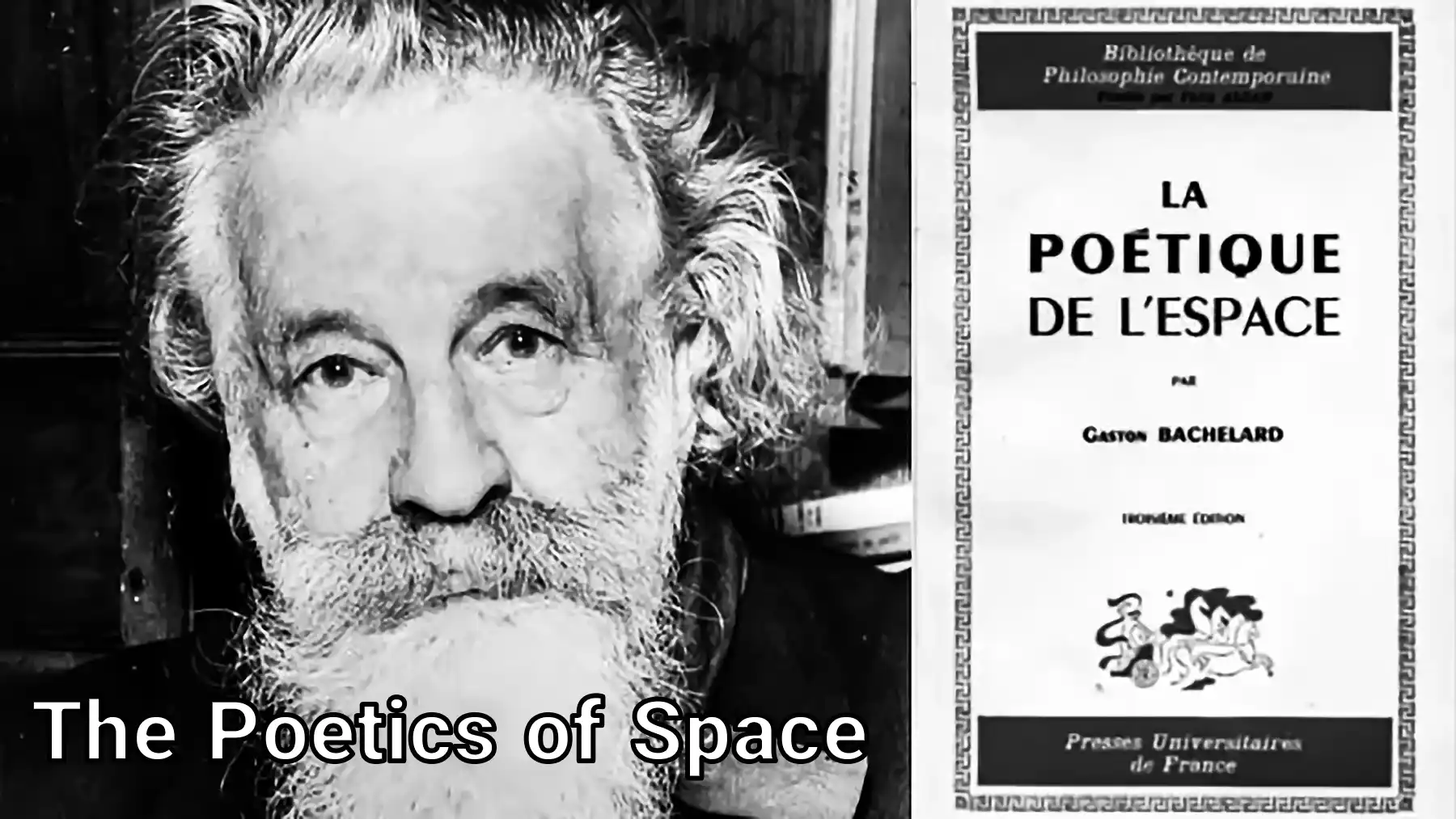
In the mid-twentieth century, French philosopher Gaston Bachelard (1884–1962) turned away from his earlier focus on the philosophy of science and embraced a more poetic and phenomenological inquiry into everyday life. His 1957 masterpiece, La Poétique de l’Espace (The Poetics of Space), stands as one of the most influential works in phenomenology, literary criticism, and architectural thought. Unlike traditional philosophical treatises on aesthetics, this book does not analyze art objects, monuments, or abstract concepts of beauty. Instead, it explores the intimate spaces of dwelling—houses, corners, nests, shells, drawers, and attics—as vessels of memory, imagination, and emotional resonance.
Bachelard proposes that the house is not merely a physical structure or functional container for human activity. It is, rather, the cradle of dreams, the repository of memory, and the refuge of intimacy. Through its rooms and recesses, it mediates between inner and outer worlds, embodying the dialectic of inside and outside, protection and exposure, smallness and immensity. His analysis is not scientific but phenomenological: he investigates how space is lived, imagined, and experienced through the depths of human subjectivity.
This article offers a comprehensive exploration of Bachelard’s Poetics of Space. It examines the philosophical background of the work, its central metaphors, and its implications for architecture and literature. By tracing the key chapters of the book—on the house, the nest, the shell, corners, drawers, miniature, and the dialectic of inside and outside—we discover how Bachelard transforms ordinary spaces into sites of existential meaning. Ultimately, the article argues that The Poetics of Space provides enduring lessons for architects, writers, and all who seek to understand the relationship between space, imagination, and human dwelling.
Bachelard’s Philosophical Turn
Before writing The Poetics of Space, Bachelard was renowned as a philosopher of science, authoring works on epistemology such as The New Scientific Spirit (1934). He investigated how scientific knowledge progresses by rupturing older ways of thinking, and he emphasized the discontinuity of scientific revolutions. Yet in his later years, Bachelard made a decisive intellectual shift. He moved from the rational and causal world of science to the poetic and imaginative world of lived experience.
This transition was not a rejection of science but an expansion of philosophy into realms that reason alone could not penetrate. In The Poetics of Space, he describes his new method as a “phenomenology of imagination.” While phenomenology traditionally investigates the structures of consciousness, Bachelard adapts it to focus on how images, metaphors, and poetic experiences shape our sense of space. Instead of analyzing the concept of “house” scientifically or sociologically, he investigates how houses are remembered in dreams, poems, and childhood recollections.
The book thus represents the culmination of Bachelard’s intellectual journey. Published when he was 73 years old, it reflects a mature philosophy that seeks to reconcile reason with imagination, reality with poetry. Its legacy lies precisely in this unusual fusion: Bachelard bridges philosophy, psychology, literature, and architecture, offering a vision of space that is both intimate and universal.
The House as a Phenomenological Category
At the heart of The Poetics of Space is the conviction that the house is more than an architectural structure. It is a psychological and ontological category. Bachelard insists that “the house is our corner of the world,” the first universe we inhabit. It shelters not only our bodies but also our memories, our solitude, and our imagination.
He illustrates this with a famous metaphor drawn from Carl Jung: a house that appears to be a nineteenth-century structure but whose basement belongs to the sixteenth century, built on foundations of the eleventh, beneath which lies a prehistoric cave. This layered image symbolizes the stratification of the human psyche. Just as a house has an attic and a cellar, so too does the human mind contain levels of consciousness and unconsciousness.
Verticality: Cellar and Attic
Bachelard emphasizes the verticality of the house. The attic, with its beams and sloping roof, represents clarity, logic, and rational thought. It is a space where the dreamer contemplates from above, closer to the sky. The cellar, by contrast, is a realm of darkness and mystery. It evokes fear, unconscious depths, and the unknown. Between these poles lies the ground floor, where everyday life unfolds.
This vertical axis is central to the phenomenology of dwelling. The attic and cellar are not simply architectural features but archetypal images of human psychology. They embody the dialectic of light and dark, conscious and unconscious, safety and fear. Through them, Bachelard shows how physical spaces resonate with psychic structures.
House as Memory
The house also functions as a repository of memory. Childhood homes remain imprinted in our consciousness long after their physical walls have collapsed. Even forgotten corners resurface in dreams. For Bachelard, to remember a house is to remember oneself; to re-inhabit its rooms is to re-inhabit one’s own inner life. Thus, the house is not only a shelter but also a mirror of the soul.
Nests, Shells, and Intimate Spaces
Beyond the human house, Bachelard turns to nature’s shelters: nests and shells. These serve as metaphors for intimacy, solitude, and protection.
The Nest
The nest is fragile, suspended, and precarious. Built on a shaky branch, it epitomizes both vulnerability and security. Paradoxically, its very instability heightens our dream of safety. Bachelard asks: If there were no trust in the world, would a nest ever be built? The nest thus embodies the human longing for intimacy and belonging, even amid instability. It is a psychological image as much as a natural phenomenon.
The Shell
The shell (or mollusk’s house) represents a different kind of intimacy: layered, enclosed, and enduring. A mollusk does not build first and then move in; rather, it lives by building and builds by living. Its shell grows with it, embodying the unity of life and dwelling. For Bachelard, this illustrates the principle that architecture should not be imposed externally but should grow organically from life itself.
The shell also symbolizes solitude. To live in a shell is to embrace loneliness, to accept that intimacy sometimes requires withdrawal. Yet shells persist even after their inhabitants die. The empty shell becomes a metaphor for the body without soul, a reminder that material forms outlast their occupants. In this sense, the shell is both protective and melancholic, both a home and a tomb.
Dialectics of Intimacy
Both nest and shell reveal Bachelard’s fascination with dialectics: smallness and immensity, fragility and stability, life and death. Each intimate space condenses contradictions, inviting us to experience the complexity of dwelling. In them, we see how the poetics of space transforms natural phenomena into existential metaphors.
Corners, Drawers, and Hidden Spaces
One of the most original contributions of The Poetics of Space is its attention to small, hidden spaces: corners, drawers, closets, and cupboards. These may seem trivial, but for Bachelard, they are the refuges of intimacy.
Corners
The corner is where solitude is most concentrated. It is a retreat from the openness of the room, a place where the dreamer crouches and withdraws. To inhabit a corner is to build a miniature house around one’s body, to construct a cocoon of intimacy. Corners are not empty; they are seeds of imagination.
Drawers and Closets
Similarly, drawers, cupboards, and chests are metaphors for hidden inner worlds. They contain secrets, memories, and intimate possessions. Opening them is like entering another dimension of the self. For Bachelard, the aesthetics of hidden objects reveals our psychological need for secrecy and protection. Even locks symbolize not only security but also the boundaries of intimacy.
The Phenomenology of the Hidden
These examples show how Bachelard transforms ordinary objects into phenomenological events. A drawer is not merely storage; it is a threshold to memory and imagination. A corner is not wasted space; it is a sanctuary for solitude. Such insights challenge architects and designers to recognize the existential significance of the smallest details.
The Poetics of Smallness and Miniature
Another key theme in the book is the poetics of miniature. For Bachelard, smallness is not merely a reduction of scale. It is a quality of existence that intensifies intimacy and concentrates meaning. A dollhouse, a tiny box, or even a map of a house can contain a folded world—a cosmos compressed into miniature form.
Miniature objects act as condensers of lived experience. They invite the imagination to expand, paradoxically transforming smallness into immensity. The more delicate and detailed an object, the wider the field of dreams it evokes. For this reason, models and mock-ups in architecture are not merely technical tools; they are laboratories of imagination. They allow us to rehearse the feelings and memories that real spaces will one day evoke.
Home, World, and the Dialectic of Inside and Outside
Throughout the book, Bachelard explores the tension between the intimacy of home and the hostility of the outside world. He illustrates this with images of the winter hut and the storm-battered house.
The winter hut, surrounded by snow, is warm inside, with thick curtains holding back the cold. It becomes a metaphor for the house as a defense against the hostile world. Similarly, the sturdy house that withstands storms symbolizes strength and maternal protection. In both cases, the dialectic is clear: home vs. world, inside vs. outside, intimacy vs. hostility.
Yet this opposition is never absolute. The house mediates between inside and outside, between intimacy and exposure. Old houses, even when collapsed, continue to live in our dreams. Forgotten homes resurface as refuges of memory, reminding us that the line between past and present, reality and dream, inside and outside, is porous.
The House of Memory and Imagination
For Bachelard, memory is inseparable from dwelling. Every house we have lived in remains alive in us. Childhood homes, in particular, shape the structure of our imagination. Even when demolished, their rooms persist in dreams, carrying the “hierarchy of dwelling” forever inscribed in our souls.
Poetry plays a central role in expressing these memories. Bachelard draws on poets such as Rilke, Baudelaire, and Persian poet Sohrab Sepehri to show how houses live on in verse. A ruined house may awaken nostalgia and regret, yet it also reveals the endurance of intimacy. As long as we dream, the houses of our past remain alive within us.
Architectural Lessons from Bachelard
What lessons does The Poetics of Space hold for architects and designers today?
- Design for Intimacy, Not Just Function
Architecture is not only about utility or form but about creating spaces where imagination and memory can dwell. - Embrace Smallness and Detail
Corners, recesses, and miniature elements enrich the dwelling. They are not marginal but central to the lived experience of space. - Respect the Dialectics of Space
Inside/outside, light/dark, cellar/attic—these contrasts give meaning to architecture. Designing with them in mind deepens the experiential quality of buildings. - Architecture as Refuge of Dreams
Ultimately, architecture should be understood as poetic dwelling—a space where the soul finds shelter, intimacy, and resonance.
Bachelard thus reminds us that architecture is not just a technical discipline but a poetic art of creating homes for memory and imagination.
Conclusion
Gaston Bachelard’s The Poetics of Space remains one of the most profound explorations of human dwelling. By turning from science to imagination, he illuminated the poetic depth of everyday spaces. Houses, nests, shells, corners, and drawers are not trivial objects; they are metaphors of existence, mirrors of the soul, and cradles of dreams.
The book challenges us to reconsider how we design, inhabit, and remember spaces. It invites us to see architecture not as geometry but as intimacy materialized. In an age of anonymous high-rises and digital life, Bachelard’s insights are more relevant than ever. They remind us that the true essence of architecture lies in its ability to provide a refuge for dreams, a place where imagination, memory, and life converge.
As Bachelard himself might say: If space is the refuge of dreams, then architecture is nothing less than the most poetic form of dwelling.
