


Where Architecture and Poetry Converge: The Hasht Behesht Palace of Isfahan
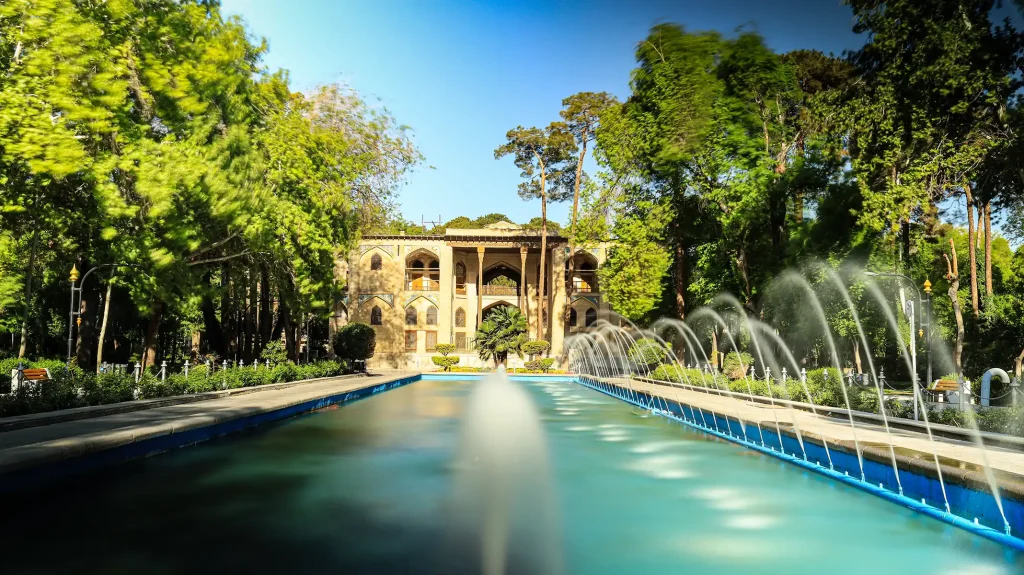
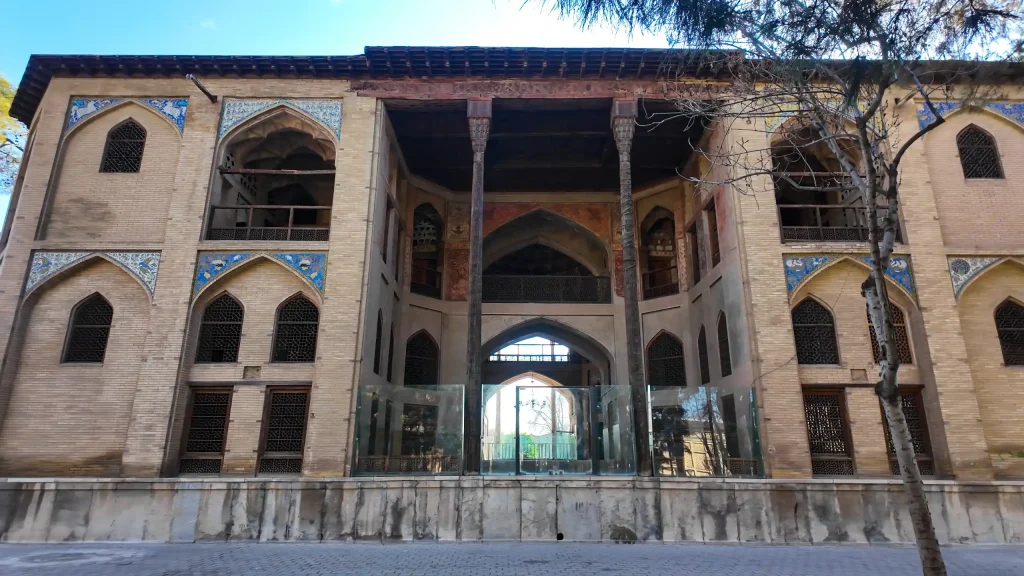
Nestled within the historic heart of Isfahan, the Hasht Behesht Palace — meaning “Eight Paradises” — stands as one of the finest surviving examples of Safavid-era architecture. Constructed during the reign of Shah Solayman I around 1670, this two-story pavilion reflects the architectural genius and cultural sophistication of late Safavid Iran. Situated within the lush expanse of the Bolbol (Nightingale) Garden, Hasht Behesht represents the culmination of Persian garden design — a harmonious synthesis of geometry, symbolism, spatial ingenuity, and environmental awareness.
Although no dated inscription exists on the building, historical sources, poems, and traveler accounts trace its origins to the reigns of Shah Abbas I, Shah Safi, and Shah Abbas II, with its completion under Shah Solayman. Chroniclers such as Jaberi Ansari attribute its construction to royal patronage, and poets like Mirza Mohammad-Taher Nasr-abadi celebrated the master builder, Maqsud, who brought the palace to life.

Historical Evolution
The palace once stood within the grand Bolbol Garden, originally a part of the Naqsh-e Jahan complex. According to 17th-century sources, the ensemble was larger than the Chehel Sotoun Garden and extended across several acres, arranged along the majestic Chahar Bagh Avenue. European visitors like Jean Chardin and Pascal Coste described Hasht Behesht as one of the most enchanting palaces of its time — more graceful and poetic, they wrote, than any royal residence in Europe.
Over the centuries, Hasht Behesht underwent numerous transformations. During the Qajar period, Fath-Ali Shah and Nasser al-Din Shah commissioned restorations and added new decorative layers, including paintings, gilded panels, and mirror work. Madame Jane Dieulafoy, who visited during the late 19th century, described portraits of Fath-Ali Shah and his sons adorning the walls. However, these embellishments were later concealed under layers of plaster and lost to time.
After the Qajar era, the property passed into private hands and parts of the garden were subdivided for urban expansion. In 1964, the palace and its remaining grounds were transferred to the Ministry of Arts and Culture, which initiated a careful restoration campaign. Layers of later plaster were removed to reveal the original Safavid decorations — delicate stuccowork, painted wood ceilings, and the remains of colorful tiles.
The Octagonal Plan and Spatial Harmony
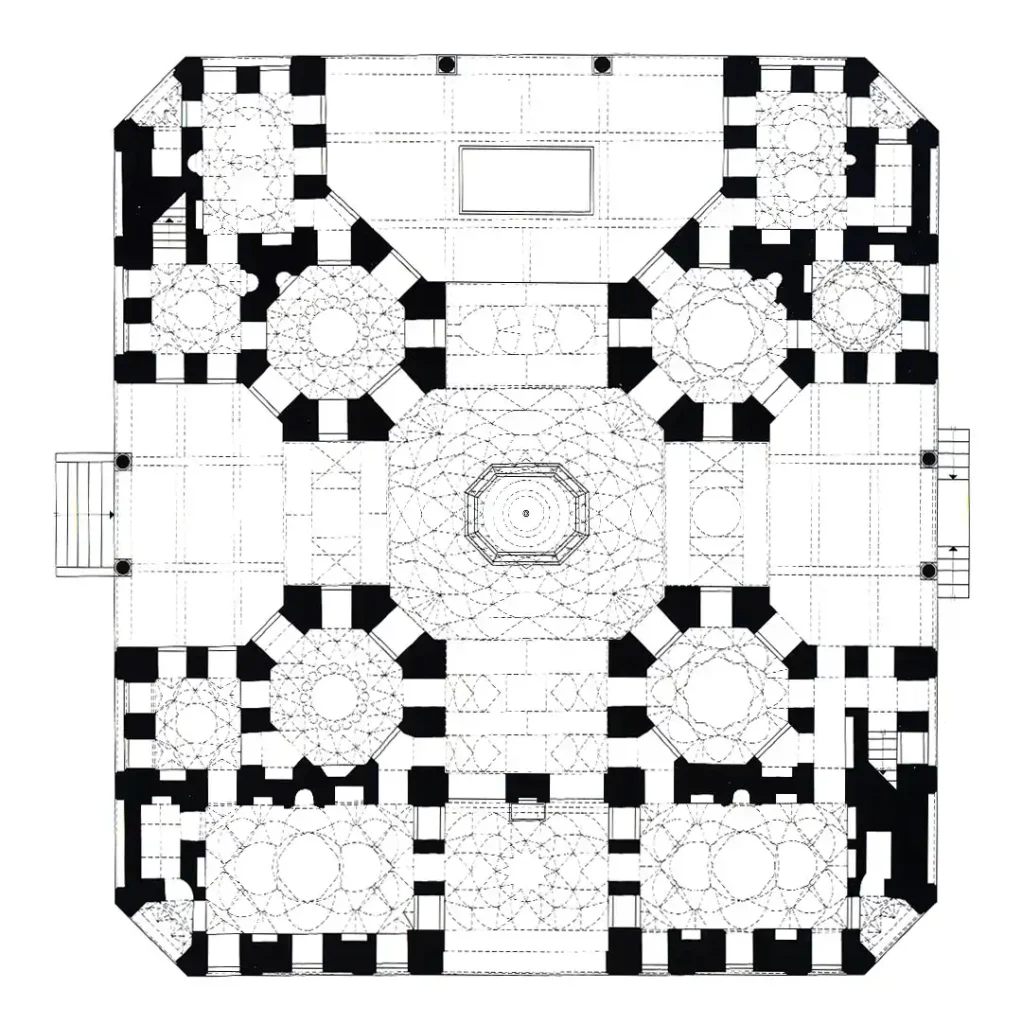
The very name Hasht Behesht encapsulates its essence: the “Eight Paradises” of Islamic cosmology. The building’s octagonal plan symbolizes the ordered harmony of heaven and earth. At its core lies a domed central chamber, surrounded by four axial iwans (vaulted porticoes) and four diagonally placed rooms — an architectural interpretation of the classical Persian chahar-taq (four-arch) typology.
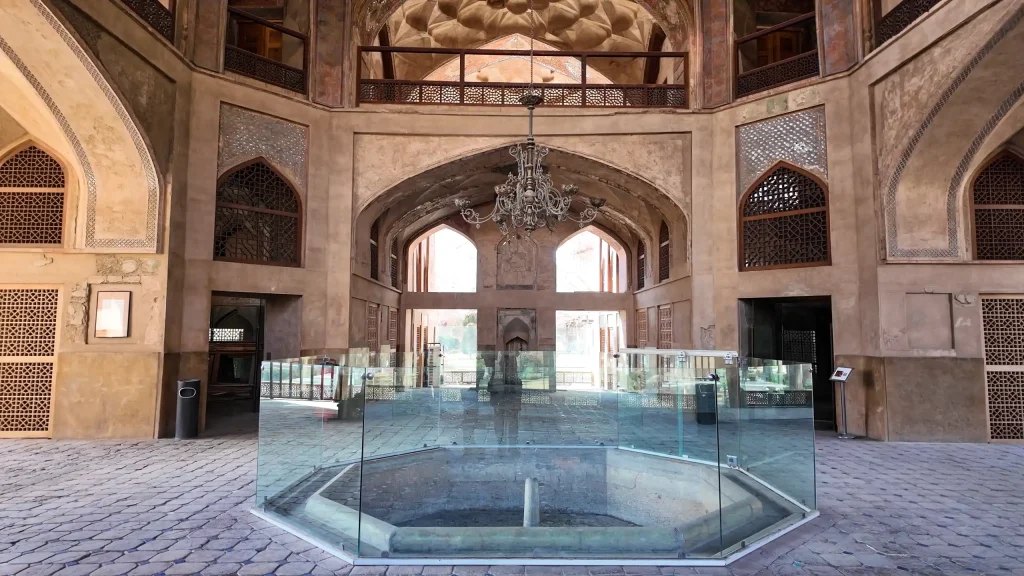
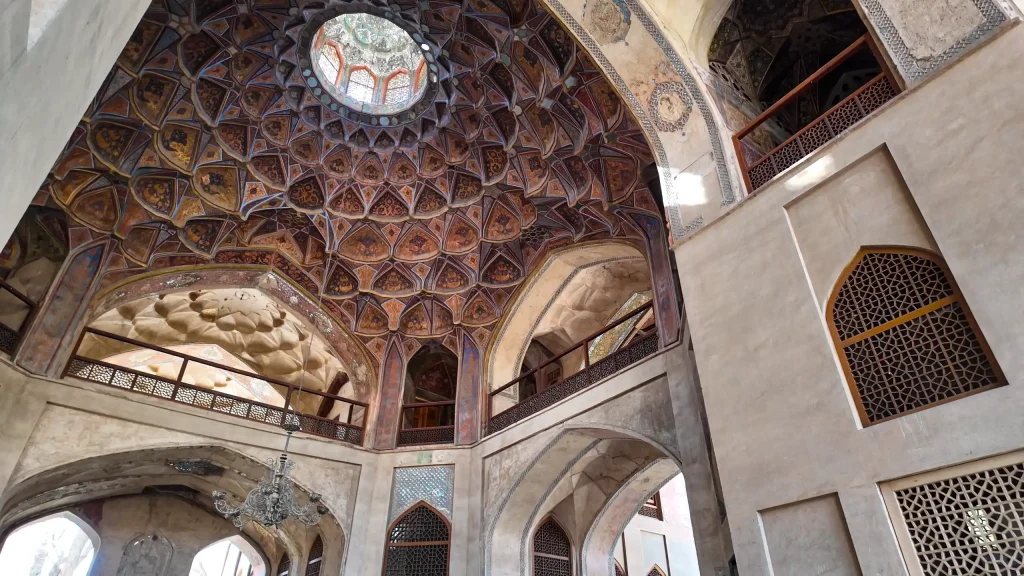
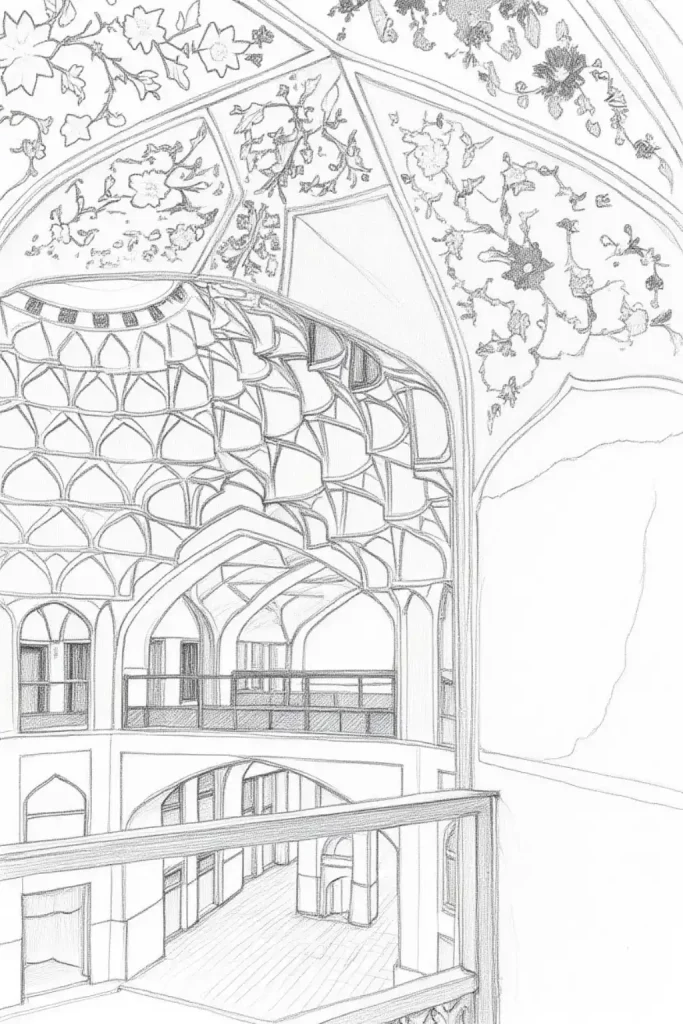
This ingenious configuration creates a sense of both symmetry and variation. The central space, crowned by a dome resting on muqarnas (stalactite-like) squinches, opens in all four cardinal directions, fostering fluid movement between interior and exterior. Diagonal staircases link the two levels, leading to an upper floor composed of smaller rooms connected by a surrounding corridor. These rooms offer alternating experiences of openness and seclusion — a delicate balance between collective gathering and private retreat, between architectural order and lived intimacy.

Architectural Elements: Iwans, Water, and the Garden
Each of the four iwans opens toward a distinct vista of the surrounding garden, creating a continuous dialogue between the built form and the landscape. The northern iwan, more pronounced than the others, once framed a view of the main axis of the Bolbol Garden. This spatial choreography epitomizes the Persian ideal of unity between architecture and nature — where walls and water, shade and light, geometry and vegetation converge to create a living paradise.
Water channels and shallow marble pools formed an integral part of the design. These reflective surfaces doubled the visual presence of the structure, creating a shimmering interplay of light and texture. As water flowed through stone conduits and cascaded from upper to lower basins, it animated the space with sound and movement — both cooling the air and enriching the sensory experience.
Structural Techniques and Materiality
Built of brick and plaster, Hasht Behesht demonstrates the Safavid mastery of masonry construction. Despite the use of heavy load-bearing walls and massive piers, the pavilion feels airy and permeable, thanks to the strategic placement of openings, niches, and colonnades. Wooden beams support the ceilings, while the central dome elegantly transitions from a square base to a circular apex through the use of muqarnas and squinches — a hallmark of Persian architectural ingenuity.
Tahvil-dar Esfahani, a chronicler of the time, recorded that the palace stood between two long pools stretching east–west, with smaller channels intersecting the garden’s geometry. The surrounding stone and brick enclosure featured arched openings and decorative niches, uniting structure and ornament in perfect proportion.
Decorative Program and Symbolism
The Hasht Behesht Palace dazzles not only through its spatial design but also through its intricate decorative language. Stucco reliefs, mirror mosaics, painted wooden ceilings, and colorful tiles once covered nearly every surface. Inside, walls were adorned with motifs of vases, flowers, birds, and mythical creatures such as the simurgh, the Persian phoenix.
The color palette — lapis blue, gold, turquoise, and ochre — evoked cosmic and paradisiacal imagery. These decorations were not merely ornamental; they embodied spiritual and philosophical meanings drawn from Persian poetry, Sufism, and nature. The upper northwest chamber, known as the “Golden Room,” preserves traces of gilded ornamentation and floral paintings that once sparkled under natural light filtering through lattice windows.
Environmental Responsiveness
Beyond its beauty, Hasht Behesht demonstrates remarkable environmental intelligence. The building’s orientation and fenestration ensure natural ventilation: cool breezes circulate through its latticed windows, while the pools and gardens moderate temperature and humidity. In winter, fireplaces integrated within the thick walls provided warmth. Skylights and perforated screens filter daylight to create a soft, dappled illumination — enhancing both comfort and atmosphere.
The water cascade from the upper marble basin into a lower pool symbolized the eternal flow of life, reflecting the harmony between natural forces and divine order — a key theme in Persian garden philosophy.
Legacy and Conclusion
Today, although much of its decoration has faded and its surrounding gardens have been reduced, Hasht Behesht remains a profound expression of Persian architectural thought. It represents the zenith of Safavid art — a synthesis of geometry, craftsmanship, environmental adaptation, and metaphysical symbolism.
Visitors who step into Hasht Behesht encounter not merely a relic of the past, but a living echo of Iran’s architectural philosophy — where structure becomes poetry, and space becomes a reflection of paradise itself. As global architects increasingly seek inspiration from sustainable and human-centered design, Hasht Behesht continues to stand as a timeless model — a jewel of Isfahan that bridges art, nature, and the infinite realm of imagination.